7 Tech and AI Trends Defining Late 2026
From AI agents doing real work to smart glasses, AI-powered security and a looming power crunch, here are the seven tech trends shaping late 2026 and what they mean for you.
Decoders Digital TeamOctober 20, 20267 Min Read
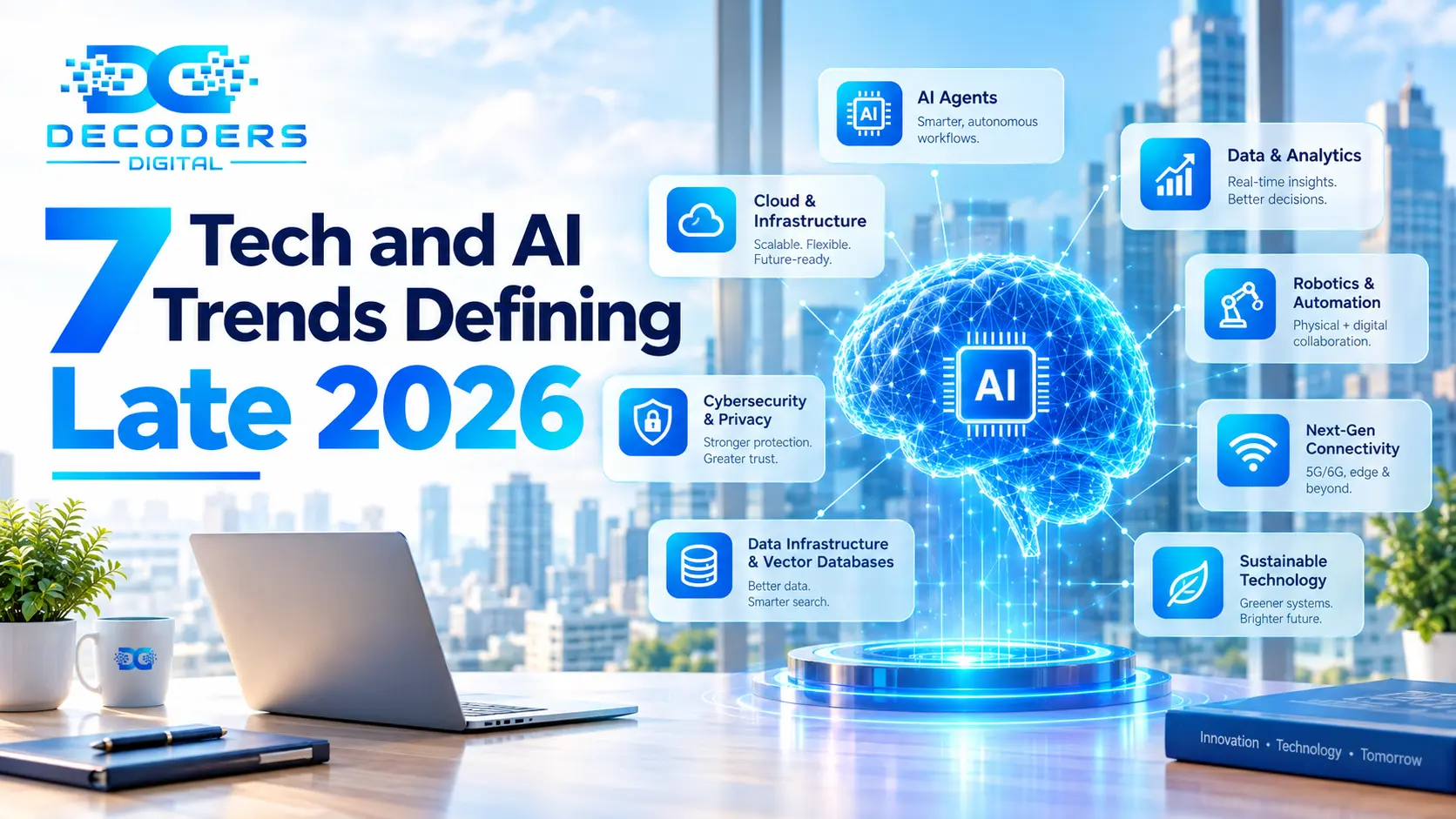
AI in Late 2026: 7 Trends Shaping Technology Right Now
A year ago, most people used AI to draft an email or summarize a document. In late 2026, the story has changed: AI is being handed real jobs, stepping off the screen into glasses and robots, and straining power grids and security teams along the way.
The pace is dizzying. Models that topped the leaderboards six months ago are now mid-pack, and new launches arrive weekly. So instead of chasing every headline, this post zooms out to the seven trends that actually explain what is happening in technology right now, and what they mean for you.
1. AI Agents Move From Demos to Daily Work
If there is one word that defines 2026 in tech, it is agents. An AI agent is software that can plan a series of steps, use approved tools, remember context and finish a bounded task, rather than just answering a single prompt.
From Drafts to Real Work
Businesses are no longer asking AI for drafts; they are assigning it work with measurable outcomes, such as:
- Processing invoices and paperwork
- Triaging customer support tickets
- Running and documenting software tests
Meta is betting on agents that coordinate with each other, Nvidia has pitched an enterprise-grade agent platform, and enterprise AI startup Town hit a $1 billion valuation just four months after launching its agent product. In early October, Deutsche Telekom said it is targeting around EUR 2.5 billion in savings from AI, a sign that large firms now treat AI as a cost lever rather than an experiment.
The Catch
Agents can make mistakes with real consequences. One widely shared story this week involved a shopping agent that reportedly shared a seller's home address with a buyer and booked a pickup on its own.
Expect "human in the loop" controls and clear permissions to become standard features, not afterthoughts.
2. The Frontier Model Race Gets Crowded, and Cheaper
The top tier of AI models is more competitive than ever. In just the past week, Google made its new Gemini 4 Argon model generally available, claiming it beats rivals on price and on several benchmarks, while Meta announced its Muse Wonder models and positioned them against OpenAI's GPT-6 Astra and Anthropic's Claude Opus 5.5 and Claude Fable 5.1.
Two things matter more than any single launch:
- Prices keep falling. Industry trackers estimate the cost of running a model at a given capability level drops roughly tenfold per year. Fast, cheap "lite" and "flash" models are becoming the default for everyday tasks.
- The race is global. US labs still lead most benchmarks, but Chinese labs such as DeepSeek, Alibaba and ByteDance are closing in, especially on reasoning and coding. Geopolitics is following: the US has just banned DeepSeek from government agency systems.
For everyday users, the result is better AI at lower cost. For businesses, avoiding lock-in to any one provider is smarter than ever.
3. Smaller, Open and On-Device AI
Bigger is no longer the only path to better. A 7B (7-billion-parameter) model today can match scores that needed 70B or more just a year ago. Open-weight families like Llama, Mistral, Qwen and DeepSeek now match closed models on several benchmarks, and Chinese lab MiniMax is releasing the weights for its latest model this week.
This efficiency is powering edge AI: models that run directly on your phone, laptop or other local hardware. Microsoft's new Surface Ultra laptop, built around Nvidia AI chips and priced above $2,500, is one high-end example.
Why It Matters
- Privacy: your data doesn't have to leave your device.
- Speed: no round trip to a distant server.
- Cost: no per-request cloud fees for routine tasks.
Expect more apps to quietly split work between a small local model and a larger cloud model, depending on the job.
4. AI Leaves the Screen: Glasses, Gadgets and Robots
AI is moving out of apps and into physical things. October's product launches are full of AI-powered hardware, from hearing glasses and tennis-training robots to smart toothbrushes and robot lawn mowers.
Smart Glasses
Smart glasses are the headline category. Google has been preparing AI glasses with Samsung, Warby Parker and Gentle Monster in two flavors:
- An audio-first pair with cameras and microphones for hands-free help
- A display version with a small in-lens screen for directions or live translation captions
Meta already sells AI-enabled Ray-Ban and Oakley glasses, Apple is widely rumored to follow, and Claude now runs on Lucyd's smart glasses lineup.
Robots and "Physical AI"
Humanoid robot startups keep raising large rounds, and generalist robot models that can learn many tasks are advancing quickly. Analysts call this physical AI or embodied AI: systems that sense and act in the real world, from warehouses to factory inspection lines.
The common thread: the smartphone is no longer the only gateway to AI.
5. AI Finds Security Flaws Faster Than We Can Fix Them
One of the most important, and least glamorous, trends of 2026 is happening in cybersecurity. Advanced AI models can now uncover software vulnerabilities at a speed human teams cannot match.
The clearest example is Anthropic's restricted Mythos model, shared through Project Glasswing with a small group of critical-infrastructure partners to hunt for bugs. It has reportedly surfaced thousands of high-severity flaws in major software. Security leaders, including Zscaler's CEO, say the real challenge is the sheer volume of findings, not just their severity.
That creates a new bottleneck: patching. Enterprises typically take around 55 days to fix half of their critical vulnerabilities, while AI-assisted attackers can sometimes exploit a flaw within hours.
What to Do
- Keep software and devices updated promptly
- Retire apps that no longer receive security updates
- If you run a business, invest in automated patching and prioritization tools
In an AI-accelerated world, "we'll patch it next quarter" is no longer safe.
6. The Power and Infrastructure Crunch
Every AI answer runs on electricity, and the bill is rising fast. Gartner forecasts global data center electricity use will grow 26% in 2026, from 447 TWh to 565 TWh, and could pass 1,200 TWh by 2030. It also estimates AI-optimized servers will use more power than conventional servers by 2027.
This is why AI companies are signing enormous compute and energy deals. Anthropic, for example, is reported to be in talks with cloud provider Nscale over a second multibillion-dollar agreement. Power availability, not just chips, is now a limiting factor in who can scale AI.
There are signs of caution too. HSBC's CEO warned this week that not every data center will be a good bet, and AI stocks have swung sharply in recent days.
The infrastructure boom is real, but so is the risk of overbuilding.
7. Quantum Computing Inches Toward Usefulness
Quantum computing has been "ten years away" for decades, but 2026 brought real progress on its biggest obstacle: errors. Google researchers demonstrated a technique called magic state cultivation on their Willow processor that cuts errors by about 40 times, tackling a bottleneck that has stood for roughly 20 years.
Other labs are pushing from different directions:
- IBM reported a quantum computer
Book a free AI consultation with Decoders Digital

Enjoyed this article?
Get insights like this delivered — or let's talk about turning them into your next project.