EHR in Healthcare: From Digital Records to Connected Healthcare Workflows
EHR adoption is already widespread across U.S. healthcare, but digital records alone do not create connected workflows. Learn how APIs, FHIR, automation, AI, and custom software can help healthcare organizations reduce manual work and make existing EHR environments more connected and useful.
Decoders Digital TeamSeptember 22, 20268 Min Read
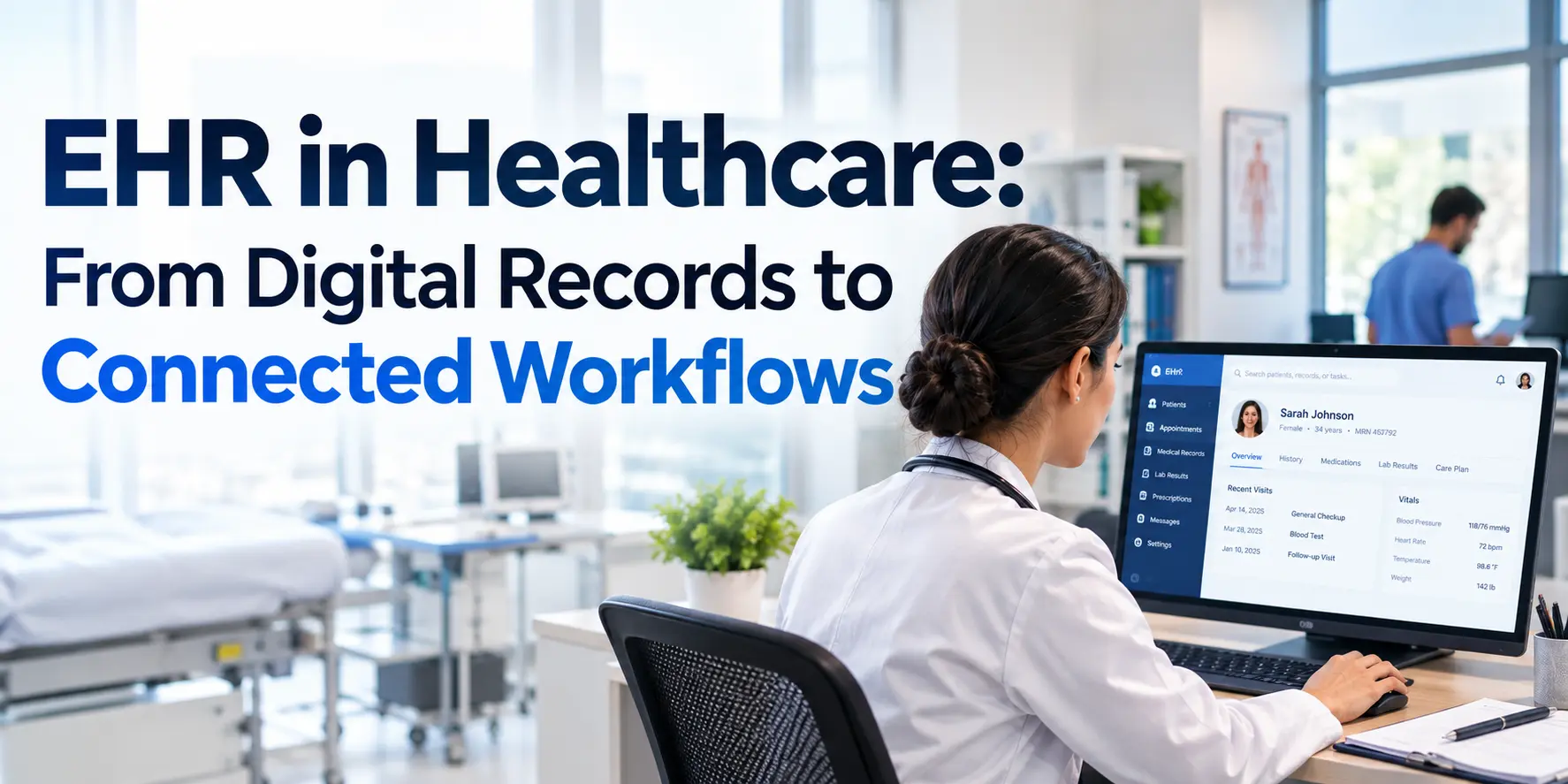
EHR in Healthcare: From Digital Records to Connected Healthcare Workflows
Healthcare Technology | 2026 Edition
Electronic Health Records have fundamentally changed how healthcare organizations store, access, and manage patient information.
For years, the primary goal was straightforward: move healthcare records from paper into digital systems.
That goal has largely been achieved.
According to the Office of the National Coordinator for Health Information Technology (ONC), 91% of U.S. office-based physicians used a certified EHR in 2024, while more than 99% of non-federal acute-care hospitals had adopted a certified EHR.
The healthcare industry has largely solved the problem of digitizing the patient record. The next challenge is making that digital record work across the entire healthcare workflow.
The question for healthcare leaders is no longer simply whether an organization has an EHR.
It is:
What happens around the EHR once the information is there?
Scheduling systems, payer platforms, laboratories, pharmacies, patient portals, analytics tools, custom applications, and AI systems increasingly need to interact with the patient record.
That creates a new technology challenge:
How can healthcare organizations turn a digital record into a connected, actionable workflow?
1. The EHR Adoption Problem Has Changed
Digital records were the first step. Connected workflows are the next.
The first generation of EHR adoption focused primarily on digitization.
Healthcare organizations replaced paper charts with electronic records, created digital clinical documentation, managed medications electronically, accessed laboratory results, and established centralized repositories for patient information.
That transformation was significant.
ONC's national data shows that office-based physician EHR adoption increased from 42% using any EHR in 2008 to 91% using a certified EHR in 2024.
ONC's June 2026 data brief describes physician EHR adoption as nearly ubiquitous.
EHR adoption has moved from a digitization challenge to a connectivity and workflow challenge.
But widespread adoption exposed another problem.
Healthcare organizations do not operate through a single application.
They operate through interconnected systems:
- EHR platforms
- Scheduling systems
- Payer systems
- Laboratory systems
- Pharmacy systems
- Patient portals
- Billing platforms
- Referral systems
- Analytics platforms
- AI applications
The EHR may remain the central system of record, but it does not automatically coordinate everything that happens around that record.
This is where the next stage of EHR modernization begins.
The objective is no longer simply to store more information.
It is to make information available, usable, and actionable wherever the workflow requires it.
2. Modern EHRs Are Becoming Part of a Larger Healthcare Technology Stack
The EHR is increasingly becoming one component of a connected technology environment.
A modern healthcare organization may have dozens of systems involved in a single patient journey.
A patient might enter through a scheduling platform, provide information through a patient portal, have eligibility checked through a payer system, receive clinical care through an EHR, complete laboratory testing through another system, and receive follow-up communication through a separate application.
The EHR sits in the middle of this environment.
But information has to move between systems for the overall process to work efficiently.
ONC's 2025 hospital interoperability data shows how far healthcare organizations have progressed in exchanging information.
In 2025:
- 96% of U.S. non-federal acute-care hospitals reported electronically sending health information.
- 93% reported receiving health information electronically.
- 94% reported being able to find health information electronically.
- 79% reported integrating information into their own systems.
- 76% engaged in all four measured interoperability domains.
The difference between exchanging information and integrating information is important.
A system can successfully send a record to another organization without automatically incorporating that information into the next step of a workflow.
Data exchange answers the question "Can the information move?" Workflow integration answers the question "What happens when it arrives?"
That distinction is becoming increasingly important for healthcare organizations.
| EHR Capability | What It Enables | Operational Impact | |---|---|---| | Digital records | Centralized patient information | Less paper and manual storage | | Data exchange | Information moves between organizations | Better coordination | | APIs | Applications communicate with EHRs | Connected digital ecosystem | | FHIR | Standardized data exchange | Greater interoperability | | Workflow integration | Information triggers next actions | Less manual work | | AI integration | Information can be interpreted and summarized | Greater operational capacity | | Analytics | Workflow performance can be measured | Better decision-making |
The strategic opportunity therefore moves from:
EHR adoption → EHR integration → workflow automation → connected healthcare operations
3. The Real Value of an EHR Is What Happens Around the Record
The EHR stores the information. The workflow creates the operational value.
An EHR contains patient information, but healthcare organizations create value through the actions that happen around that information.
Consider a patient referral.
A referral may contain:
- Patient demographics
- Clinical notes
- Medications
- Previous test results
- Insurance information
- Supporting documents
In a disconnected process, employees may still need to manually download documents, enter information into another system, verify insurance, contact the patient, and create follow-up tasks.
The EHR has digitized the record.
But the surrounding workflow remains manual.
A connected workflow could instead move information through the process automatically:
Referral received → Information extracted → Required information checked → Eligibility verified → Task created → Staff notified → Patient contacted
This does not mean that every step should be automated.
Instead, technology can handle repetitive movement and classification while people remain responsible for appropriate review and decisions.
The value of an EHR is not only the information it stores. It is how effectively that information supports the next action.
This changes the question healthcare executives should ask.
Instead of:
"How much information can we put into the EHR?"
The better question becomes:
"How much unnecessary work can we eliminate around the information already in the EHR?"
4. APIs and FHIR Are Changing What EHRs Can Become
Connectivity becomes valuable when it supports a meaningful workflow.
Modern EHRs are increasingly expected to participate in an ecosystem of applications rather than operate as isolated systems.
ONC reports that in 2024 approximately nine in ten hospitals enabled patients to access their health information through an API, while about seven in ten hospitals used standards-based APIs such as HL7 FHIR for that patient access.
APIs provide a technical foundation for connecting EHR information with other applications.
For example, an organization may connect its EHR with:
- Patient-facing applications
- Analytics platforms
- Workflow systems
- Payer services
- AI applications
- Custom software
This means healthcare organizations can extend existing EHR environments without necessarily replacing the underlying system.
But an API connection alone does not create transformation.
Moving data between systems is only the beginning. The real value comes when that connection changes what happens next.
For example:
Data transfer
Patient information moves from the EHR to another application.
versus:
Workflow automation
Patient information moves → the system evaluates the information → the appropriate task is created → an employee receives an exception only when human intervention is required.
The second model connects technology directly to the workflow.
That is where EHR integration begins to overlap with automation and AI.
5. Where AI Fits Into the EHR
AI becomes more useful when it works inside the workflow rather than beside it.
AI is increasingly being positioned as another layer around the EHR.
Rather than replacing the EHR, AI can help healthcare professionals interpret, summarize, organize, and act on information contained within or connected to the record.
Potential use cases include:
- Clinical documentation assistance
- Chart summarization
- Information extraction
- Patient communication drafts
- Referral processing
- Administrative classification
- Workflow support
The American Medical Association reported in 2026 that 81% of surveyed physicians were using AI professionally, with documentation, chart summaries, research summaries, and patient communications among the reported applications.
AI generates more operational value when it becomes part of an existing process rather than creating another system for employees to manage.
Consider a simple example.
An AI system can summarize information from a patient's record.
But the summary still needs to go somewhere.
The workflow needs to determine:
- Where the summary is stored.
- Who reviews it.
- Whether an action is required.
- What happens after the review.
- How the result is recorded.
Without that surrounding workflow, AI may simply produce another output that employees have to manage manually.
With workflow integration, the process can become:
Patient record → AI analysis → Relevant information identified → Appropriate workflow triggered → Human review where required → Result recorded
This is where AI can become part of the healthcare operating model rather than simply another software feature.
6. Having an EHR Does Not Mean You Have Digital Transformation
Digitization and workflow transformation are two different stages.
Healthcare organizations have already made enormous progress in digitization.
More than 99% of U.S. non-federal acute-care hospitals and 91% of office-based physicians had adopted certified EHRs by 2024.
But the presence of an EHR does not automatically mean that the surrounding workflow is digital.
An organization can have a modern EHR while employees still depend on:
- Spreadsheets
- Emails
- Manual status checks
- Disconnected portals
- Repetitive data entry
- Manual handoffs
- Workarounds
It can have an API while employees still manually trigger the next step.
It can even have AI while employees continue copying information between systems.
The presence of digital technology does not automatically eliminate manual work.
The next opportunity is therefore not necessarily another EHR implementation.
It is the operational layer around the EHR.
Healthcare leaders should identify:
Where does information get stuck?
Where do employees repeatedly move data?
Where do systems fail to communicate?
Where are repetitive decisions still being made manually?
Where could automation or AI remove unnecessary friction?
These questions shift the focus from software ownership to workflow performance.
7. How Healthcare Organizations Can Modernize Their EHR Environment
Modernization can begin with the workflow, not with replacing the entire EHR.
The strongest starting point is identifying the processes that create the most operational friction.
A healthcare organization might begin with:
- Referrals
- Patient intake
- Prior authorization
- Eligibility verification
- Documentation
- Scheduling
- Revenue-cycle operations
The goal is to map the entire process.
For each workflow, identify:
- Every system involved
- Every manual handoff
- Every repeated data-entry step
- Every decision point
- Every exception
- Every place where information becomes unavailable or delayed
Once the workflow is mapped, organizations can determine where different technologies fit.
| Workflow Problem | Potential Technology | Example Outcome | |---|---|---| | Repetitive data movement | API integration | Less manual entry | | Systems do not communicate | FHIR/API integration | Better information flow | | Repetitive process steps | Workflow automation | Faster processing | | Large volumes of unstructured information | AI | Information extraction and summarization | | Manual monitoring | Analytics | Better workflow visibility | | Complex exceptions | Human review | Appropriate oversight |
The technology should follow the workflow requirement.
Start with the business problem. Then determine where integration, automation, custom software, or AI can solve it.
Finally, measure the result.
Useful operational measures include:
- Processing time
- Manual touches
- Error rates
- Turnaround time
- Exception volume
- Staff capacity
- Cost per transaction
These measures provide a clearer view of whether modernization is actually improving the workflow.
8. What Happens Next?
The EHR is becoming part of a broader connected healthcare platform.
The next stage of healthcare technology is unlikely to be defined by the EHR alone.
Over the next 12 months, modernization efforts will increasingly focus on:
- Interoperability
- API connectivity
- Patient access
- Workflow integration
- Practical AI use cases
The basic EHR is already established.
The opportunity is to make the surrounding ecosystem more connected and useful.
Over the next two to three years, the EHR will increasingly function as an important data and workflow hub within broader healthcare technology environments.
AI can work alongside EHR data, while APIs and workflow engines determine how information moves between systems.
Over a longer horizon, the distinction between the EHR and the broader digital healthcare platform may become less important.
Healthcare organizations will increasingly operate through connected environments where:
Clinical information → Administrative systems → Patient applications → AI services → Workflow automation
work together.
The next stage of healthcare technology is not simply more software. It is better coordination between the software organizations already use.
Key Takeaways
-
EHR adoption has largely moved beyond the question of whether healthcare organizations should digitize patient records.
-
91% of U.S. office-based physicians used certified EHRs in 2024, while more than 99% of non-federal acute-care hospitals had adopted certified EHRs.
-
The next challenge is making information move effectively across healthcare workflows.
-
Interoperability, APIs, FHIR, workflow automation, AI, and analytics can extend the value of an existing EHR environment.
-
EHR modernization does not necessarily require replacing the existing EHR.
-
The strongest starting point is understanding where information gets stuck and where employees perform repetitive manual work.
-
Digital records were the first transformation. Connected workflows are the next.
Frequently Asked Questions
What is an EHR?
An Electronic Health Record is a digital version of a patient's health information maintained by healthcare providers.
Modern EHRs can support clinical documentation, medications, orders, laboratory results, imaging, patient communication, and information exchange.
What is the difference between an EHR and an EMR?
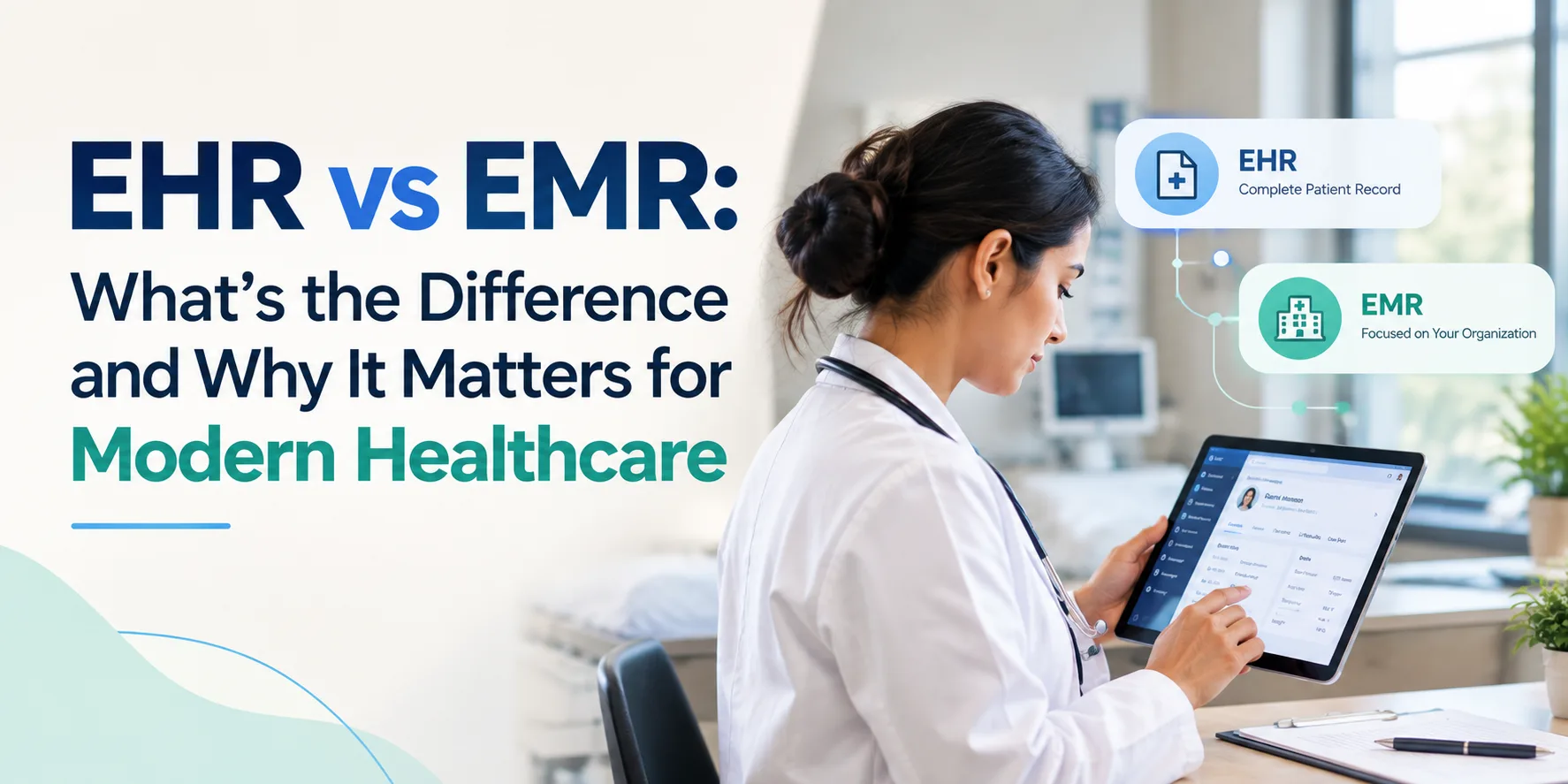
The terms are often used interchangeably, although EHR generally refers to a broader longitudinal health record designed to support information sharing across healthcare settings.
EMR traditionally refers to the digital record within a particular provider or organization.
Why is EHR integration important?
EHR integration allows information to move between the EHR and other healthcare applications such as payer systems, laboratories, pharmacies, patient portals, analytics platforms, and workflow software.
This can reduce duplicate data entry and manual handoffs.
Can AI be integrated with an EHR?
Yes.
AI can be integrated with EHR environments for use cases such as:
- Documentation assistance
- Chart summarization
- Information extraction
- Workflow support
- Patient communication
The appropriate architecture depends on the use case, data, security requirements, governance, and level of human oversight.
Does an organization need to replace its EHR to modernize?
Not necessarily.
APIs, FHIR-based integrations, workflow automation, custom applications, and AI services can extend existing EHR environments without requiring a complete replacement.
The Bottom Line
The healthcare industry has largely solved the first EHR problem:
Moving patient records from paper into digital systems.
The next challenge is making those systems work together.
A modern EHR should not be viewed as the entire healthcare technology environment.
It should be viewed as one important component of an ecosystem that includes:
- APIs
- FHIR
- Payer systems
- Patient applications
- Workflow automation
- AI
- Analytics
- Human oversight
For healthcare organizations, the opportunity is to identify where work is still manual, where information is trapped, where systems fail to communicate, and where technology can remove friction from the workflow.
Business Problem First. Technology Second.
At Decoders Digital, we help businesses approach healthcare technology from the workflow outward—connecting systems, automating processes, integrating AI, and building custom software where existing platforms cannot support the operational requirement.
Wondering how your EHR environment could become more connected and automated?
Book a free AI consultation with Decoders Digital.
Enjoyed this article?
Get insights like this delivered — or let's talk about turning them into your next project.