
EHR vs EMR: What’s the Difference and Why It Matters for Modern Healthcare
EHR and EMR are often used interchangeably, but they serve different purposes. Learn how their scope, interoperability, integrations, automation, and AI capabilities shape modern healthcare technology.
Decoders Digital TeamSeptember 24, 20267 Min Read
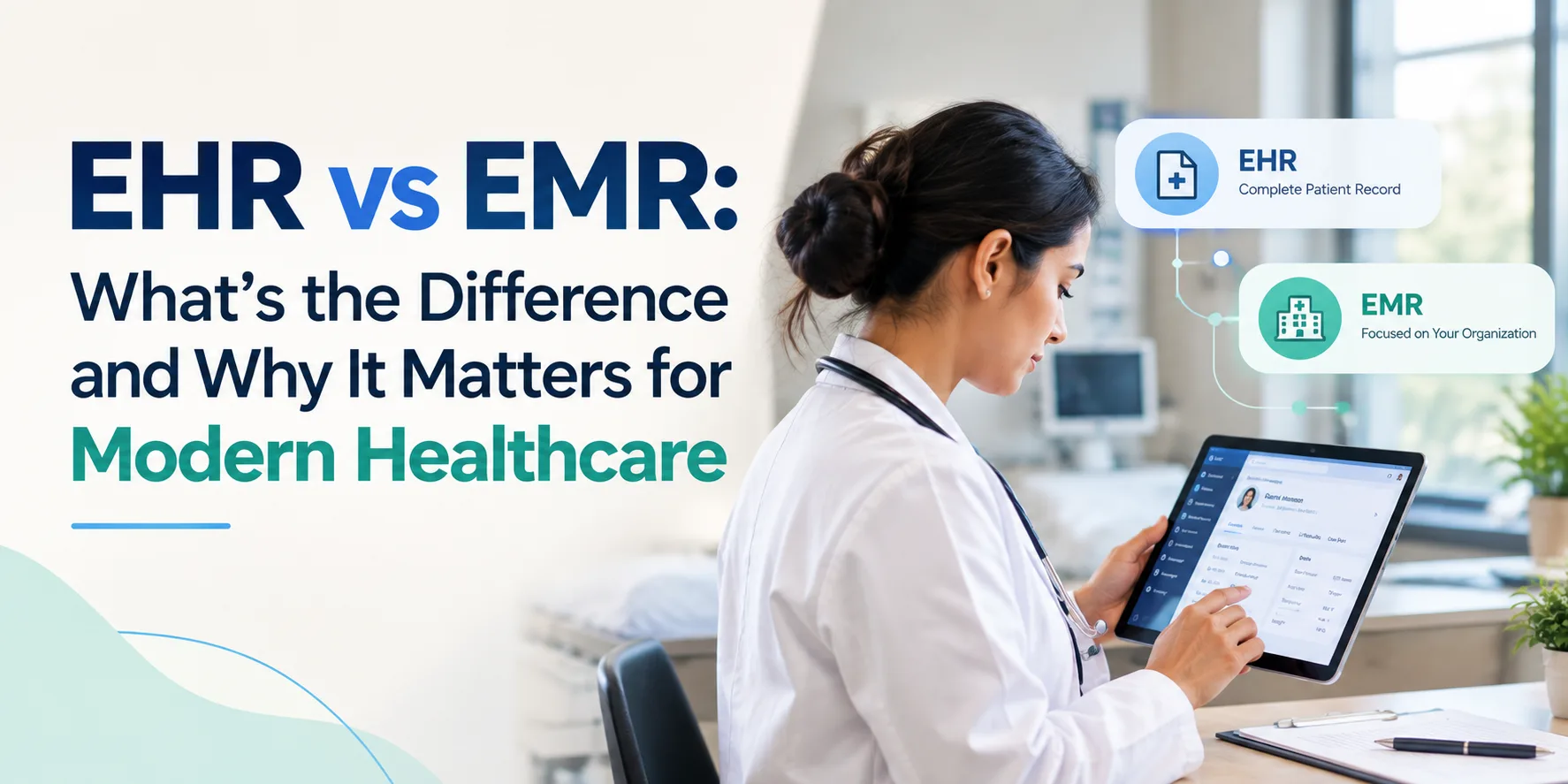
EHR in Healthcare: From Digital Records to Connected Healthcare Workflows
Electronic Health Records have fundamentally changed how healthcare organizations store, access, and manage patient information. But after years of EHR adoption, healthcare's next technology challenge is no longer simply moving from paper to digital records. It is making those digital records work effectively across the wider healthcare ecosystem.
The scale of adoption shows how far the industry has already moved. According to the Office of the National Coordinator for Health Information Technology (ONC), 91% of U.S. office-based physicians used a certified EHR in 2024, while more than 99% of non-federal acute-care hospitals had adopted a certified EHR.
91% / >99% / 81% — Office-based physicians using a certified EHR / non-federal acute-care hospitals with a certified EHR / physicians using AI professionally (ONC/ASTP, AMA 2026)
That creates an important question for healthcare leaders: if almost every major healthcare organization is already digital, why do so many workflows still feel disconnected? The answer is that an EHR can digitize information without automatically digitizing everything that happens around that information.
The shift runs through four stages: Digitization → Interoperability → Integration → Connected Operations.
1. The EHR Adoption Problem Has Changed
The first generation of EHR adoption was primarily about digitization.
ONC's national data shows EHR adoption among office-based physicians rising from 42% in 2008 to 91% using a certified EHR in 2024 — described as nearly ubiquitous in ONC's June 2026 data brief.
But once digital records became standard, a different problem became visible: healthcare organizations increasingly have multiple digital systems surrounding the EHR — scheduling platforms, payer systems, laboratories, pharmacies, patient portals, billing applications, referral platforms, analytics tools, and AI products. The EHR became an important system of record, but it could not by itself solve every workflow problem.
- Digitizing information → making that information available, usable, and actionable across the workflows that depend on it
2. Modern EHRs Are Becoming Part of a Larger Healthcare Technology Stack
An EHR should no longer be viewed as an isolated application.
ONC's 2025 hospital interoperability data illustrates the progression:
- 96% of non-federal acute-care hospitals reported electronically sending health information
- 93% reported receiving it
- 94% reported being able to find information electronically
- 79% reported integrating information into their own systems
- 76% engaged in all four measured interoperability domains
That difference matters. Being able to send or find information is not the same as having it automatically integrated into the workflow.
| EHR Capability | What It Enables | Business Impact | |---|---|---| | Digital records | Centralized patient information | Less paper/manual storage | | Data exchange | Information moves between organizations | Better coordination | | APIs | Applications communicate with EHRs | Digital ecosystem | | FHIR | Standardized data exchange | Interoperability | | Workflow integration | Information triggers next actions | Less manual work | | AI integration | Information can be interpreted and summarized | Greater operational capacity | | Analytics | Workflow performance can be measured | Better decision-making |
The strategic opportunity therefore moves from EHR adoption to EHR utilization: how effectively can an organization use the information already inside its systems?
3. The Real Value of an EHR Is What Happens Around the Record
An EHR contains information, but healthcare organizations create value through what they do with it.
Consider a patient referred to a specialist. If the receiving organization has to manually download documents, re-enter information, verify insurance separately, contact the patient, and create follow-up tasks, the EHR has not eliminated the operational burden.
- Manual referral handling → connected workflow: identify the referral → extract relevant information → check whether required information is present → connect with eligibility systems → create the appropriate task → notify staff about exceptions → make information available in the right workflow
This distinction is important for healthcare executives because the goal should not be "How much can we put into the EHR?" The better question is "How much unnecessary work can we eliminate around the information already in the EHR?"
4. APIs and FHIR Are Changing What EHRs Can Become
Modern EHRs are increasingly expected to participate in an ecosystem of applications rather than operate as closed systems.
ONC reports that in 2024, approximately nine in ten hospitals enabled patients to access health information through an API, while about seven in ten used standards-based APIs such as HL7 FHIR for patient access.
- View health information online — 99%
- Download information — 96%
- View clinical notes — 95%
- Securely message provider — 92%
- Transmit to a third party — 84%
- Patient access via any API-based app — 81%
- Patient access via FHIR-based app — 70%
But connectivity by itself does not create transformation. The real value comes when an API connection supports a meaningful business workflow — a patient record moving between applications is useful; a patient record automatically triggering the right next action is considerably more valuable.
Related: EHR integration and API connectivity (Decoders Digital)
5. Where AI Fits Into the EHR
AI is increasingly being positioned as another layer around the EHR — not a replacement for it.
Potential use cases include clinical documentation assistance, chart summarization, information extraction, patient communication drafts, referral processing, administrative classification, and workflow support. The AMA reported in 2026 that 81% of surveyed physicians were using AI professionally, with documentation, chart summaries, research summaries, and patient communications among the reported applications.
AI generates value when it is connected to the process — not merely when it produces an impressive output.
For example, an AI system might summarize relevant information from a patient's record, but the workflow should also determine where that summary goes, who reviews it, what action follows, and how the result is recorded.
6. Reality Check: Having an EHR Does Not Mean You Have Digital Transformation
EHR adoption is not the same as workflow transformation.
An organization can have a modern EHR while employees still rely on spreadsheets, emails, manual status checks, disconnected portals, repetitive data entry, and workarounds. It can have an API while staff still manually trigger the next step. It can even have AI while employees continue moving information between systems.
It is building the operational layer around the EHR.
Healthcare leaders should evaluate where information gets stuck, where employees repeatedly move data, where systems fail to communicate, and where a connected workflow could produce measurable improvements.
7. How Healthcare Organizations Can Modernize Their EHR Environment
The strongest starting point is not replacing the EHR. It is identifying the workflows that create the most friction around it.
- Map a process — referrals, patient intake, prior authorization, eligibility verification, documentation, scheduling, or revenue-cycle operations
- Identify every system involved and every point where an employee manually moves information or makes a repetitive decision
- Determine what can be connected through APIs or standards such as FHIR
- Determine what should be automated through workflow logic
- Determine where AI can provide useful interpretation or summarization — keeping high-risk clinical or operational decisions under appropriate human oversight
- Measure the result: processing time, manual touches, error rates, turnaround time, exception volume, staff capacity, and cost per transaction
8. What Happens Next?
Over the next 12 months, EHR modernization will increasingly focus on interoperability, API connectivity, patient access, workflow integration, and practical AI use cases.
Over the next two to three years, the EHR is likely to become an increasingly important data and workflow hub, with AI working alongside EHR data and workflow engines/APIs determining how information moves.
Over a longer horizon, the distinction between the EHR and the broader digital healthcare platform may become less important, as organizations increasingly operate through connected environments.
The competitive advantage will not necessarily come from owning the most software. It will come from making the software work together effectively.
Key Takeaways
- Certified EHR adoption is already above 90% among office-based physicians and above 99% among non-federal acute-care hospitals.
- The next challenge is what organizations do with that digital foundation, not whether to digitize.
- Sending and finding information is not the same as integrating it into the workflow — that gap is where friction lives.
- The real value of an EHR comes from what happens around the record, not just what's stored inside it.
- APIs and FHIR provide the technical foundation for connecting EHRs to a wider ecosystem, but connectivity alone isn't transformation.
- AI adds value when it's wired into an existing workflow, not when it's simply another interface to manage.
- Having a modern EHR doesn't mean a workflow is optimized — evaluate where information still gets stuck.
- The most valuable EHR strategy is usually not replacement — it's understanding the workflows around it.
Frequently Asked Questions
What is an EHR?
An Electronic Health Record is a digital version of a patient's health information maintained by healthcare providers. Modern EHRs can support clinical documentation, medications, orders, laboratory results, imaging, patient communication, and information exchange.
What is the difference between an EHR and an EMR?
The terms are often used interchangeably, although EHR generally refers to a broader longitudinal health record designed to support information sharing across healthcare settings, while EMR traditionally refers to the digital record within a particular provider or organization.
Why is EHR integration important?
EHR integration allows information to move between the EHR and other healthcare applications such as payer systems, laboratories, pharmacies, patient portals, analytics platforms, and workflow software. This can reduce duplicate data entry and manual handoffs.
Can AI be integrated with an EHR?
Yes. AI can be integrated with EHR environments for use cases such as documentation assistance, chart summarization, information extraction, workflow support, and patient communication. The appropriate architecture depends on the use case, data, security requirements, governance, and level of human oversight.
Does an organization need to replace its EHR to modernize?
Not necessarily. APIs, FHIR-based integrations, workflow automation, custom applications, and AI services can extend existing EHR environments without requiring a complete replacement.
The Bottom Line
The healthcare industry has largely solved the first EHR problem: moving patient records from paper into digital systems. The harder challenge is now making those systems work together.
A modern EHR should not be viewed as the entire healthcare technology environment — it should be viewed as an important part of an ecosystem that includes APIs, FHIR, payer systems, patient applications, workflow automation, AI, analytics, and human oversight.
Business Problem First. Technology Second.
At Decoders Digital, we help businesses approach healthcare technology from the workflow outward — connecting systems, automating processes, integrating AI, and building custom software where existing platforms cannot support the operational requirement.
Book a free AI consultation with Decoders Digital
Enjoyed this article?
Get insights like this delivered — or let's talk about turning them into your next project.