
AI & Automation
How AI Is Reshaping the Real Estate Industry
Discover how AI is reshaping the real estate industry through property analytics, lead management, workflow automation, and connected systems. Learn how real estate businesses can overcome data challenges, improve efficiency, and turn AI adoption into measurable business value.
Decoders Digital TeamOctober 09, 20268 Min Read
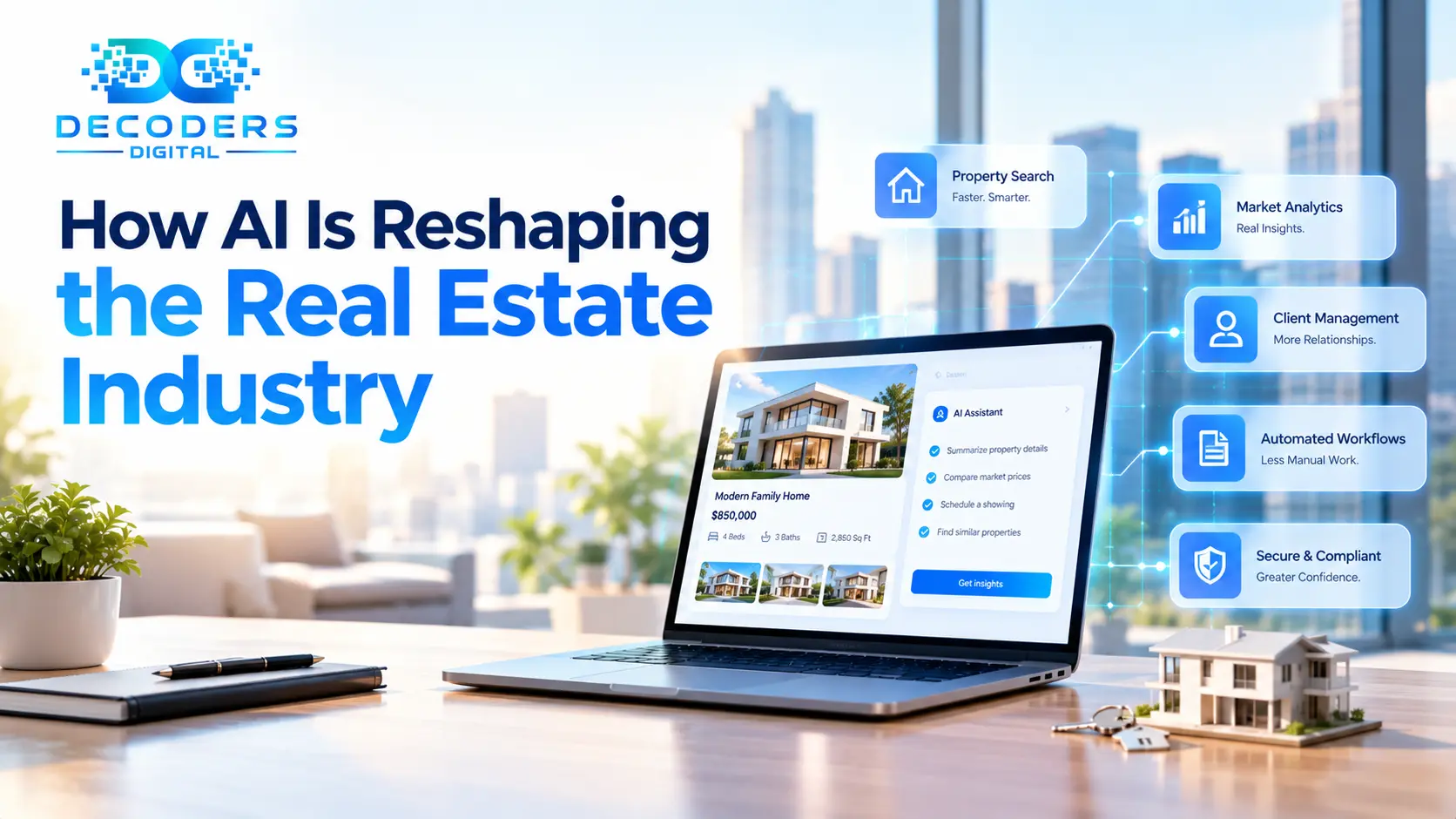
## How AI Is Reshaping the Real Estate Industry

Real estate has always been a data-heavy business. Property information, tenant behavior, market trends, transactions, maintenance, leasing, and financial reporting generate large amounts of information. **The challenge is turning that data into faster decisions, better operations, and measurable business value.**

AI is helping real estate businesses analyze information, automate repetitive tasks, improve lead management, and support investment decisions. The shift is moving beyond basic chatbots toward AI-powered property operations, connected systems, workflow automation, market analysis, and smarter investment decisions.

> **88%** — Investors, owners, and landlords who had started piloting AI, pursuing an average of five AI use cases simultaneously (JLL, 2025 Global Real Estate Technology Survey)

The shift runs through four stages: **Chatbots** → **Property Operations** → **Connected Systems** → **Smarter Investment Decisions**.

---

### 1. The Real Opportunity Is Bigger Than Chatbots

*AI is moving from simple assistance to real estate business operations.*

AI in real estate is expanding beyond content generation and basic assistants — into property operations, financial planning, risk management, market analysis, portfolio optimization, and investment decisions.

- **81%** of commercial real estate respondents identified data and technology as the area most likely to receive increased spending — **76%** were researching, piloting, or implementing AI (Deloitte)
- **48%** of agents use AI daily or weekly — **81%** cite saving time as their primary reason for adopting technology (NAR, 2026)

> The opportunity is not simply using AI to complete individual tasks. It is improving how the entire real estate business operates.

---

### 2. AI Adoption Does Not Guarantee Results

*Experimentation is easy. Achieving measurable ROI is harder.*

- **90%** of real estate companies were piloting AI → but only **5%** had achieved most of their AI program goals (JLL)
- Only **14%** of respondents believed their organization had well-structured data collection and management processes alongside robust privacy policies (Deloitte)

> AI cannot compensate for disconnected systems, poor-quality data, or inefficient business processes.

Without reliable data and clearly defined workflows, AI initiatives can remain isolated experiments rather than scalable business solutions.

---

### 3. What Real Estate Businesses Should Focus On

*Start with business problems, not technology.*

An effective real estate AI strategy begins by identifying where teams lose time, information becomes disconnected, or repetitive processes slow down operations.

- **Property management automation** — streamline routine administrative tasks and property-related workflows
- **AI-powered lead management** — organize inquiries, support lead qualification, and improve follow-up processes
- **Real estate data analytics** — analyze property and market information to support better decisions
- **Automated reporting** — reduce repetitive data collection and report preparation
- **CRM and property system integration** — connect customer information with existing property management tools
- **Investment decision support** — use relevant data to support market analysis and portfolio planning

The right use case depends on the business, its existing systems, the quality of its data, and the results it wants to achieve.

---

### 4. Connected Systems Create More Value

*AI becomes more useful when it works within existing business workflows.*

Real estate businesses often depend on multiple platforms for customer relationships, property listings, financial reporting, maintenance, leasing, and operations. When these systems operate separately, employees end up transferring information manually and repeating the same work across applications.

- Standalone AI tool → **AI + Quality Data + Connected Systems + Redesigned Workflows**

Real estate software integration can connect these systems and help information move between them more efficiently — automation handles the repetitive tasks, while AI supports summarization, classification, analysis, and decision support.

*Related: CRM and property system integration (Decoders Digital)*

---

### 5. How to Build a Practical AI Strategy for Real Estate

*Successful implementation starts with a clear problem and measurable outcomes.*

1. **Identify the problem** — find repetitive, slow, or data-heavy processes that affect operations
2. **Map the workflow** — understand how information moves between employees, systems, and customers
3. **Evaluate the data** — check whether the required information is accessible, accurate, and appropriately governed
4. **Connect the systems** — use suitable integrations and APIs to reduce disconnected processes
5. **Implement automation and AI** — apply technology to specific tasks where it can provide measurable value
6. **Measure performance** — track processing time, manual effort, response times, operational costs, and other relevant outcomes
7. **Improve continuously** — refine the workflow based on actual performance and user feedback

> The goal is not to deploy the most AI tools. The goal is to solve important business problems reliably.

---

### 6. The Future of AI in Real Estate

*The next stage is business transformation, not just technology adoption.*

AI will continue influencing how real estate professionals analyze markets, manage leads, coordinate property operations, and process information. But long-term value depends on more than choosing an AI model or purchasing software — businesses also need reliable data, connected applications, clear workflows, appropriate privacy controls, and human judgment for important decisions.

> AI is best positioned as a tool that supports real estate professionals, reduces repetitive work, and improves decision-making — not as a replacement for the relationships and expertise that remain central to the industry.

---

## Key Takeaways

1. AI adoption in real estate is growing — businesses are exploring applications across property operations, analytics, lead management, and investment decisions.
2. Adoption does not guarantee ROI — poor data quality, disconnected systems, and unclear goals can prevent AI projects from delivering value.
3. Workflow automation creates practical opportunities — start with repetitive tasks and processes that can be improved measurably.
4. Integration matters — connecting CRM, property management, reporting, and other systems can reduce manual work.
5. Business outcomes should guide AI strategy — measure improvements in efficiency, response times, operational costs, and decision-making.

---

## Frequently Asked Questions

### How is AI being used in real estate?

AI is being used for property analysis, lead management, market forecasting, document processing, customer support, workflow automation, and portfolio management.

### Why are real estate companies investing in AI?

AI can help reduce repetitive work, analyze large amounts of property data, support decision-making, and help teams respond to customers more efficiently.

### Is AI replacing real estate professionals?

Not entirely. AI can automate repetitive tasks and support analysis, but human judgment remains important for negotiations, client relationships, and complex decisions.

### What prevents real estate companies from getting more value from AI?

Common barriers include poor data quality, disconnected systems, legacy technology, unclear use cases, and difficulties moving AI experiments into reliable production systems.

### Where should a real estate company start with AI?

Start with a specific business problem. Identify repetitive, data-heavy, or slow processes, then evaluate whether integration, automation, or AI can deliver measurable improvements.

---

## How Decoders Digital Helps Real Estate Businesses Use AI

Real estate businesses do not need more technology simply for the sake of adopting it. They need solutions that address operational challenges and fit their existing workflows.

Decoders Digital helps businesses explore AI automation, CRM integration, custom software development, intelligent workflows, and connected business systems to reduce manual work and improve operational efficiency. The first step is understanding where your business loses time, struggles with disconnected data, or needs a more efficient workflow.

**Business Problem First. Technology Second.**

**[Book a free AI consultation with Decoders Digital](/contact)**
AI in Real Estate, Real Estate Technology, Artificial Intelligence, Real Estate Automation, Property Management, Real Estate CRM, AI Analytics, Workflow Automation, Digital Transformation, Custom Software Development

Enjoyed this article?
Get insights like this delivered — or let's talk about turning them into your next project.